What does live option buying on Nifty, BankNifty and SENSEX actually look like in practice?
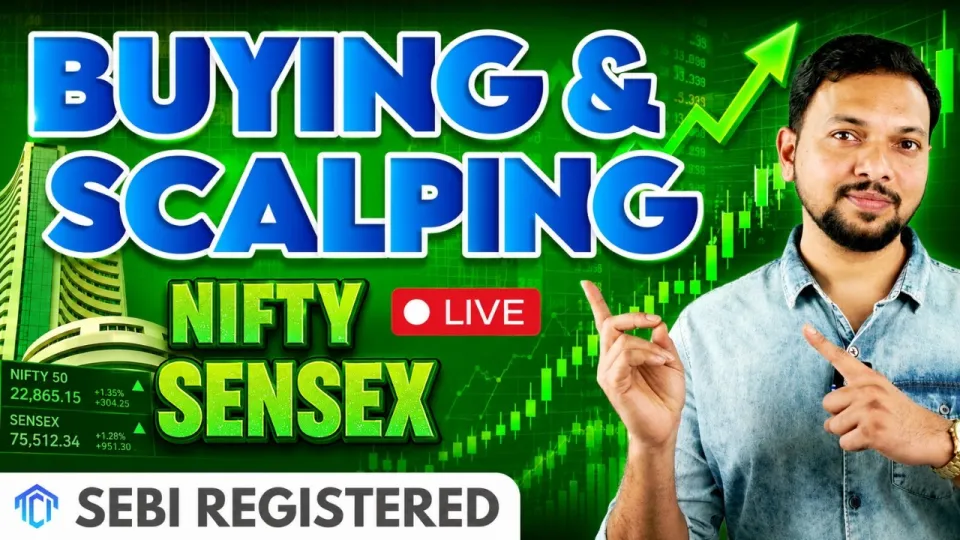
Video: LIVE TRADING Nifty BankNifty and SENSEX | Option Buying | 15 Oct #livetrading
Want articles like this for your own video to promote it on YouTube and Google? Order them through the Telegram bot @sat_sit_bot. The bot writes and publishes the articles itself (with your YouTube video embedded) on popular topical websites (no ads). Your first 50 articles are free.
· based on the channel TRADING CAFE INDIA
Key takeaways
- Live option buying means purchasing call or put options intraday on Nifty, BankNifty and SENSEX rather than selling premium.
- SENSEX options trade on BSE with a much larger contract value than Nifty, so lot size and margin differ sharply.
- Index option premiums move fast: a 100-point Nifty move can double or halve an at-the-money strike within minutes.
- A single losing session of about 13,000 rupees is a normal outcome for an undisciplined intraday options trader.
- SEBI-registered research analysts must display a registration number, as TRADING CAFE INDIA does with INH000013767.
Trading in the live market means buying call or put options on Nifty, BankNifty and SENSEX during the session and managing those positions as price moves, rather than holding overnight or selling premium for theta. The approach suits traders who can watch the screen, accept fast losses and size positions so that one bad trade does not erase a week of gains. Access to structured setups and a broker account is the practical starting point, for example through this registration and bonus offer.
What live option buying on Indian indices actually involves
Live option buying is an intraday strategy in which a trader purchases a call when expecting the index to rise and a put when expecting it to fall, paying a premium instead of posting full futures margin. The three instruments most Indian retail traders watch are the Nifty 50 and BankNifty on NSE and the SENSEX on BSE. Each has its own lot size, tick behavior and expiry cycle, so a setup that works on Nifty does not automatically transfer to SENSEX.
Key mechanics to understand before the first trade:
- Premium, not price. You pay the option premium, so the maximum loss on a long position is the premium paid plus brokerage and charges.
- Delta and speed. At-the-money strikes move roughly half a point for every point the index moves; deep out-of-the-money strikes move less in absolute terms but can lose value very quickly.
- Expiry effect. On expiry day, time value collapses toward zero, and cheap far strikes can swing 50% or more in minutes in both directions.
- Liquidity. Nifty weekly options are the most liquid; SENSEX strikes away from the money can have wide bid-ask spreads that quietly eat returns.
How index levels and strike selection drive the trade
Strike selection is the single biggest lever on risk in live option buying, because it decides how much premium is at stake and how violently the position reacts to a given index move. A trader watching the SENSEX near a round level such as 74,300 or 73,000 is really asking two questions: where is the market likely to stop, and which strike converts that view into the best risk-to-reward.
A practical routine looks like this:
- Mark the previous day's high, low and close on all three indices before the open.
- Identify one clear intraday reference level per index, such as a round number or the previous day's low.
- Choose a strike close enough to the money that it tracks the index, and check the spread before entering.
- Decide the exit level on the index before entering the option, not after the premium starts moving.
Round numbers matter because option sellers and stop orders cluster around them. Traders who expect the SENSEX to hold 73,000 or push toward 74,300 are trading a level-based thesis; the option is only the vehicle.
Position sizing and the real cost of one bad session
Position sizing determines survival in live option buying, and the rule is simple: risk a fixed small percentage of capital per trade so that a losing streak is uncomfortable but not fatal. Losing around 13,000 rupees in a single session is a common experience for retail traders who buy options without a stop, average down on falling premiums or trade too many lots after a winning streak.
A workable framework:
- Fix a maximum loss per trade, for example 1% of trading capital, and convert it into a lot count before entering.
- Never add to a losing option position; averaging down on premium is how small losses become account-level losses.
- Cap the number of trades per day, since overtrading on expiry day is the most common way to give back profits.
- Subtract brokerage, STT, exchange charges and GST from every result; on small premiums these costs are a meaningful share of the gain.
Option buying also has a structural disadvantage: the premium decays even when the index moves sideways. A trader who is right about direction but slow to act can still lose money.
Risk controls that separate a plan from a gamble
Risk control in live option buying comes down to predefined exits, because option premiums move too fast for improvised decisions under pressure. The index can travel a long way in the first hour, and a position that looked cheap at the open can be worthless by mid-session.
Use these controls consistently:
- A hard stop on the premium, set at entry and never widened.
- A time stop, for example exiting if the expected move has not started within a set number of candles.
- A daily loss limit that ends trading for the day when hit.
- A rule against holding intraday option buys overnight, since gap risk on premium is asymmetric.
- A written log of entry, exit, reason and result for every trade.
Traders who ask whether a position can be held longer should answer it with the plan, not with hope. If the thesis was an intraday level and the level failed, the trade is over.
Common questions traders raise about live index options
Most doubts from live sessions fall into a few recurring categories: whether the market already ran too far, whether a specific index target is realistic, and how to handle a position that is underwater. A move that looks extended on a 5-minute chart can still continue, and a target such as the SENSEX reaching a round level is a scenario, not a promise.
Practical answers to those recurring doubts:
- If price has already run a long way before your entry, the risk-to-reward has changed; wait for a pullback or skip the trade.
- A premium of roughly 400 points on a far strike depends entirely on volatility and time to expiry; check the implied volatility before assuming it is achievable.
- If a position is in loss and the index thesis is invalidated, exit; the premium will not recover just because the index pauses.
- Signals from Telegram channels or research services are inputs, not decisions; verify the level on your own chart.
Regulation, brokers and what to check before funding an account
Regulatory status and broker choice are part of the trading plan, not paperwork, because unregistered advisors and offshore brokers create risks that no strategy can offset. In India, research analysts must be registered with SEBI; TRADING CAFE INDIA, for instance, operates as a SEBI-registered research analyst under registration number INH000013767. Registration does not guarantee returns, and every piece of market content should be treated as educational.
Before depositing money, confirm:
- The entity's registration number and its scope, displayed on the website.
- That the broker is registered in India if you are an Indian resident; trading currency pairs without INR or using unregistered offshore brokers conflicts with FEMA rules.
- The full charge structure, including brokerage, STT and any platform fees.
- That any global broker or bonus offer is intended for the audience it is legally meant for, not for residents it excludes.
Useful links
- Research calls and registration offer: https://lemonn.co.in/affiliate-deeplink?data=lnxoh3
- Nifty and SENSEX VIP setups: https://tradingduniya.com/tools/nifty-sensex-vip-setups
- Free Telegram channel for trades and BTST news: https://t.me/tradingcafeindia
- Global broker with deposit bonus and demo competition: https://linktwin.co/dmsdah
- Crypto exchange for crypto and gold calls: https://coinswitch.co/pro/signup?code=YFwNMWq
Bottom line on trading index options live
Live option buying on Nifty, BankNifty and SENSEX rewards preparation far more than prediction: know your level, your strike, your lot count and your exit before the market opens. The strategy is simple to describe and hard to execute, because premium decay, expiry-day volatility and costs punish hesitation and oversizing. Treat every signal, including those shared in live sessions, as a starting point for your own analysis, and keep position size small enough that a losing day of a few thousand rupees never becomes a account-threatening event. The session breakdown in this article is based on the live trading format run by the TRADING CAFE INDIA channel, which streams index option buying through the trading day.
Questions & answers
Is live option buying on Nifty and SENSEX suitable for beginners?
It is possible to start small, but option buying is unforgiving because premiums decay and expiry-day moves are violent. Beginners should trade one lot of a liquid near-the-money Nifty strike, keep a hard stop on premium and log every trade before scaling up.
Why do traders lose money even when the index moves in their direction?
Because the option premium depends on time to expiry and implied volatility, not just the index level. A slow or choppy move can erode premium faster than delta adds value, and brokerage plus STT take a further bite out of small gains.
How many lots should I buy in a live session?
Size from the loss, not from the opportunity. Decide a fixed maximum loss, for example 1% of capital, and divide it by the difference between your entry premium and your stop premium to get the lot count. That number is usually far smaller than traders expect.
Do SEBI registration or a Telegram signal guarantee profits?
No. SEBI registration confirms that an analyst meets regulatory requirements; it does not assure returns or protect against losses. Signals from any channel should be verified on your own charts and executed within your own risk limits.
Source: LIVE TRADING Nifty BankNifty and SENSEX | Option Buying | 15 Oct #livetrading · Markdown version